


How AI is revolutionizing social media marketing in 2026 comes down to one shift: some tools stopped suggesting and started deciding within human-set limits. Three years ago AI wrote captions you edited. In advanced advertising platforms, it can now adjust campaigns, reallocate budget, adapt creative delivery and flag a failing ad before the next reporting cycle.
That is genuinely useful and genuinely risky, often in the same workflow. The marketers getting value from it are not the ones automating the most — they are the ones who worked out which decisions a system should make on its own and which ones still need a person to sign off.
Editorial disclosure: Overvisual is our product, so we know its workflow more deeply than the other tools mentioned here. We have tried to describe the category honestly, including where automation is a bad idea.
Key takeaways
- Some advertising platforms have moved beyond assistive features to systems that adjust targeting, messaging and bidding within human-set limits.
- Platform-side personalization increasingly uses interaction signals — watch time, skips, likes and shares — alongside broader audience and contextual data.
- Generative engine optimization matters because social platforms are search engines: 64% of US Gen Z users treat TikTok as one.
- Generative AI turns one asset into many formats, which expands reach but makes brand-voice drift the main quality risk.
- Continuous analytics can catch engagement decline while a campaign is still live instead of at the end of a reporting cycle.
- Adoption is still uneven — only 39% of agencies have significantly integrated AI — so there is a real window for teams that move now.
- Human oversight is not a nice-to-have: consumers rank human-generated content as what they most want from brands.
What changed, at a glance
| Capability | What it does now | Why it matters | Where to start |
|---|---|---|---|
| Autonomous agents | Run campaigns end to end, pivoting on live performance data | Cuts manual workload and shortens reaction time | Automate one campaign type, keep approval on creative |
| Hyper-personalization | Adapts delivery using platform-side interaction signals | More relevant delivery with less manual targeting | Start with segments you can already explain |
| AI scheduling | Automates calendars, reminders, reposts and approvals | Consistent posting without the weekly scramble | Move the calendar first — it is the safest win |
| Generative content | Turns one asset into posts, clips and carousels | More reach per idea, far less production time | Generate drafts, never publish unreviewed |
| Real-time analytics | Monitors fatigue and performance while a campaign is live | Protects ad spend mid-flight rather than after | Set alerts before you set automations |
From automation to autonomous agents
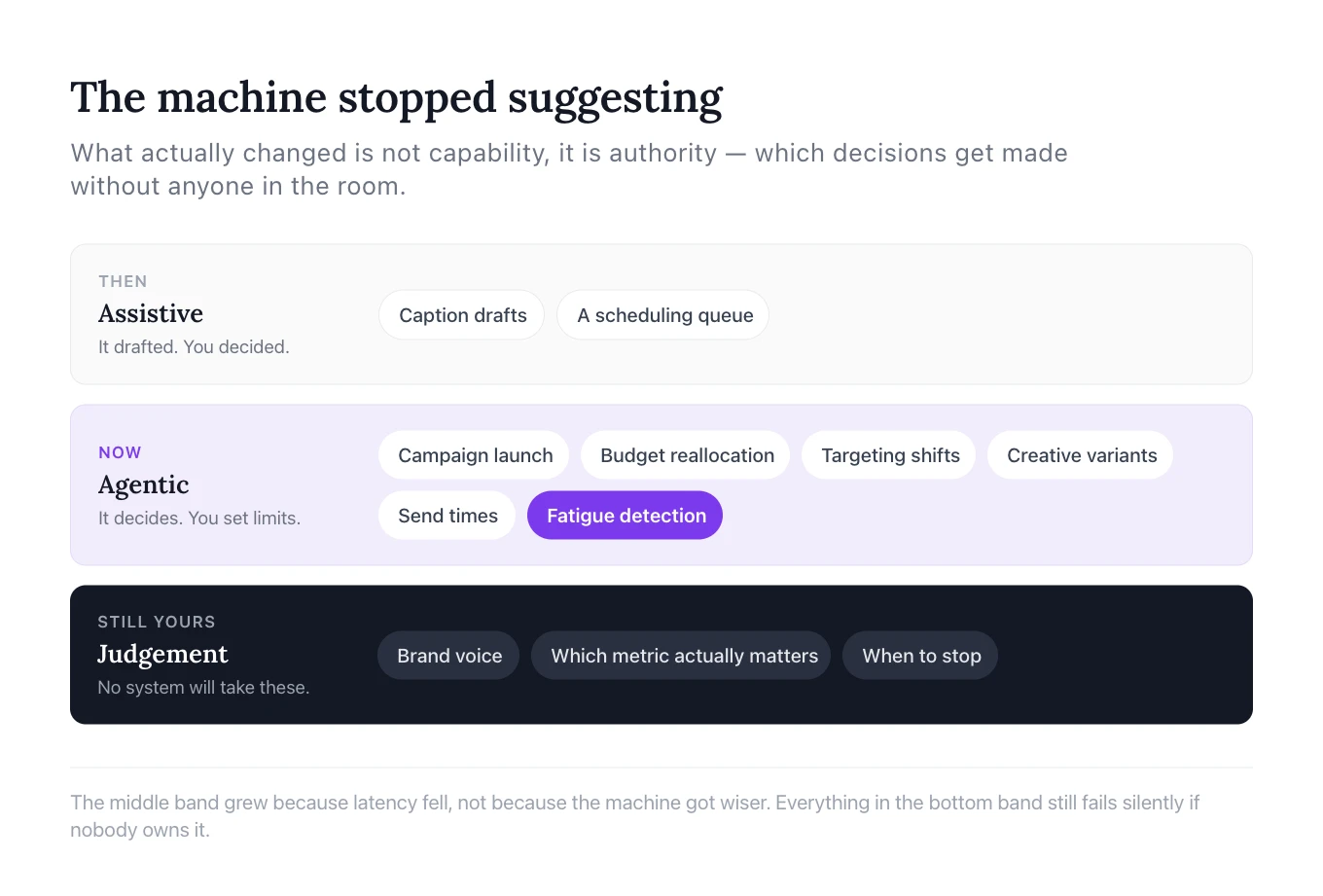
The clearest answer to how AI is revolutionizing social media marketing in 2026 is the move from tools that help to systems that act within defined limits. Earlier platforms gave you a caption generator and a scheduling queue. More advanced advertising platforms now connect content ideation, audience targeting and live optimization, so parts of a campaign can be measured and corrected without someone continuously watching a dashboard.
Adoption has not caught up with capability. Research from StackAdapt and Ascend2 found only 39% of agencies have significantly integrated AI into day-to-day workflows, with 18% barely started (StackAdapt). The gap between people trying AI and people who have actually rebuilt a workflow around it is where the advantage currently sits.
The rise of autonomous AI agents
Autonomous agents oversee campaign lifecycles rather than single tasks. They monitor performance continuously, detect shifts in engagement, and adjust messaging, targeting and bidding in response. The practical effect is that correction happens in hours rather than at the next review meeting, which matters most for paid campaigns where a declining creative keeps spending money while it fails.
The change is less about intelligence than about latency. A human marketer would make many of the same calls — they would just make them on Monday.
What agents still get wrong
Agents optimize toward the metric you gave them, which is a problem when the metric is a poor proxy for the outcome. Optimizing for engagement reliably produces content that gets engagement, not necessarily customers. They also have no memory of context they were never given: a competitor's announcement, a pricing change, a support issue currently flooding your comments.
The failure mode is not dramatic. It is a campaign that quietly optimizes into a corner — narrower audience, safer creative, decent-looking numbers, declining business impact. Set the guardrails and review the direction, not just the dashboard.
Generative engine optimization and social search
Search is no longer only a search-engine problem. Social platforms function as discovery engines, and generative AI answers increasingly sit between a question and a click. Generative engine optimization (GEO) is the practice of structuring content so it gets surfaced and cited by those systems.
This is not speculative. The original GEO research showed that optimizing content for generative engines can lift visibility in AI-generated responses by up to 40% (Aggarwal et al., GEO: Generative Engine Optimization).
Optimizing for visual and voice search
The behavioural shift is already measurable: 64% of US Gen Z users treat TikTok as a search engine, and 67% of 18–24 year-olds use Instagram to discover local businesses (Hootsuite). That means on-screen text, spoken words and captions are now ranking signals, not decoration.
Practically: put the answer in the first three seconds, say it out loud as well as showing it, and caption everything. A clip that only makes sense with sound on is invisible to a large share of the people searching for it.
What GEO means in practice
Write content that is easy to quote. Generative systems favour clear claims, concrete numbers and quotable statements attached to identifiable sources — which is why a vague paragraph of adjectives never gets cited and a specific sentence with a figure in it does.
For social specifically, that means naming the thing, stating the number, and keeping the useful sentence intact rather than splitting it across a carousel. Our guide to Instagram story text templates covers the layout side of making text legible and quotable.
Hyper-personalization and micro-behaviour targeting
Personalization is moving beyond who someone is toward how they interact with content. Platform recommendation systems can use signals such as completed views, likes, shares, follows and content a viewer chooses to skip. TikTok, for example, says a completed longer video receives more weight than weaker signals such as whether the viewer and creator are in the same country (TikTok recommendation system). Advertisers do not receive a dashboard of every micro-signal; the platform processes them and decides delivery within the campaign's settings.
Done well, this raises engagement and cuts wasted spend, because the system stops showing a message to people already signalling disinterest.
Where the signals come from
Most of these signals come from platform-side behaviour rather than anything you collect yourself. That is worth understanding, because it sets the limit of what you control: you supply creative variants, audience inputs and constraints, while the platform decides who sees which one. Your leverage is in the quality and range of the variants and the boundaries you set, not access to an individual's behaviour stream.
The privacy line
Micro-behaviour targeting is powerful enough to feel invasive when it is visible to the user. The line that matters is not legal minimums, it is whether the person would be uncomfortable if you explained how the content reached them. If describing your targeting out loud sounds creepy, it will read as creepy when it works too well.
Personalize the offer and the format. Be careful about personalizing anything that implies you know something the person did not tell you.
AI-powered scheduling platforms
Scheduling is the least glamorous part of this and usually the highest return. AI scheduling platforms automate content calendars, reminders and reposts, and connect them to approval workflows, which removes most of the coordination cost that makes consistent posting hard.
Features that actually save time
Automated reminders stop posts being missed. Evergreen recycling puts proven content back into rotation without anyone rebuilding it. Approval modules keep creators, editors and strategists in one thread instead of an email chain, which is where most delays actually happen.
Compared to the rest of this list, none of it is exciting. It is also the part that reliably works, which is why it is the sensible first move. Our comparison of AI social media manager tools breaks down which platforms lead on scheduling specifically.
Real-time content adaptation
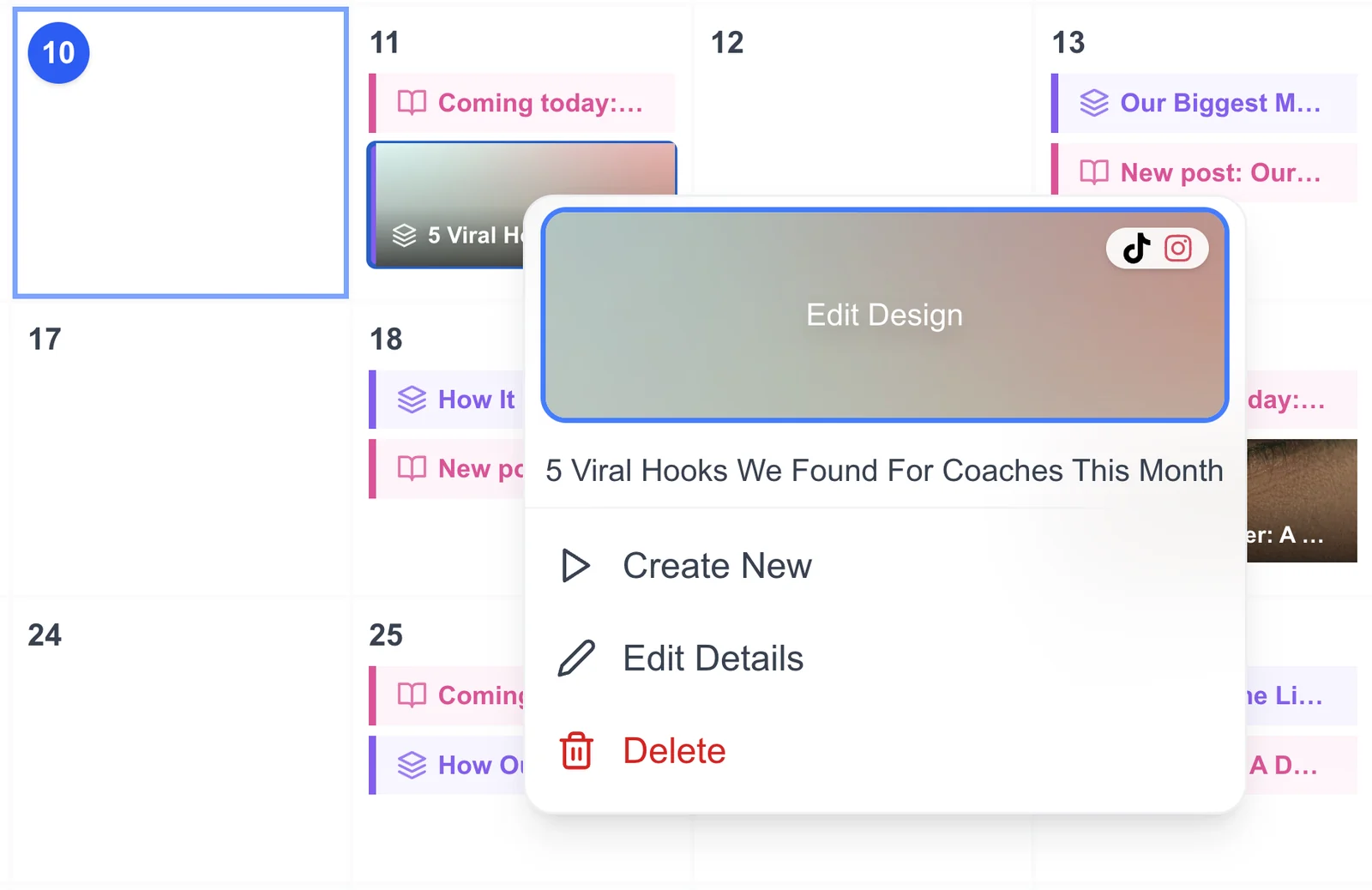
Some advanced advertising and scheduling platforms can adjust delivery, creative variants or send times using live campaign signals. The exact controls vary by platform, so automated changes need explicit budget, brand and approval boundaries.
Overvisual takes a human-controlled approach: a month of branded posts, stories and carousels can be generated in one workflow, reviewed and edited, then scheduled after approval. You can see the workflow on the features page.
AI-driven content creation
Generative tools produce captions, images and video fast enough that production stops being the constraint. The more useful capability is repurposing: one asset becomes many, sized and framed for where each one lands.
Multimodal content generation
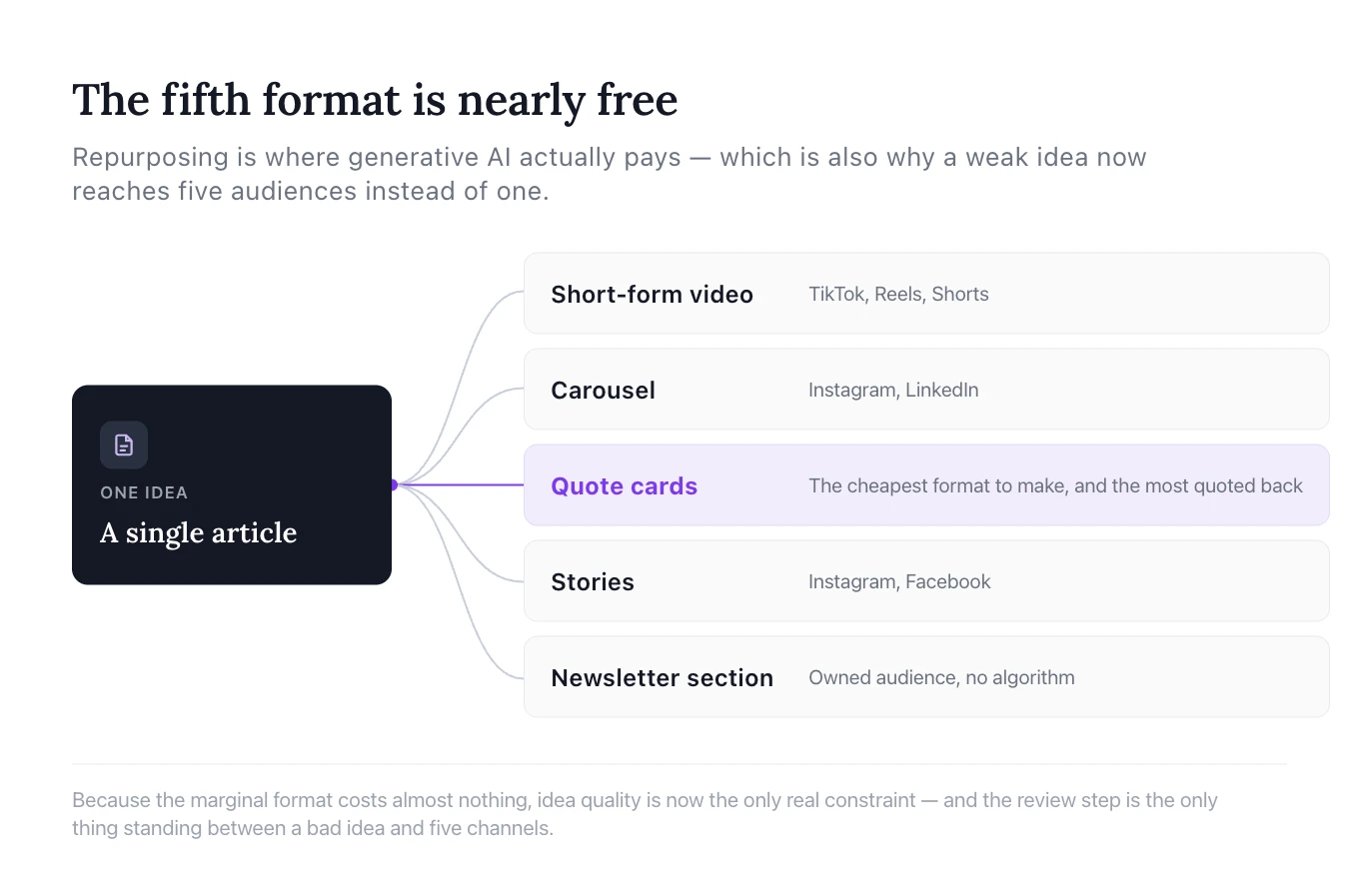
A single article can become short-form video, a carousel, an audiogram, a set of quote cards and a newsletter section. Each format reaches a different slice of the same audience, and the marginal cost of the fifth format is now close to zero.
The strategic implication is that idea quality matters more than output volume, because a weak idea now gets amplified across five surfaces instead of one. Our carousel use cases show how one concept adapts across formats without becoming repetitive.
Maintaining brand voice and authenticity
This is where the honest caveat belongs. Sprout Social's 2026 research, covering 2,300+ consumers and 1,200+ marketers, found consumers say brands should make human-generated content their number one priority (Sprout Social). Audiences are not asking for more content. They are asking for content that sounds like someone.
The workable pattern is AI for drafts and variants, humans for voice and judgement. That means someone reads everything before it publishes, and that person has the authority to bin it. If the review step is a rubber stamp, you have automation without oversight, which is how brands end up apologising for a post nobody chose to write.
Real-time analytics and optimization
Reporting used to be retrospective. Current analytics are closer to monitoring: continuous measurement with alerts when something moves, rather than a summary of what already happened.
Conversational interfaces for data
Some analytics platforms now let you ask questions in plain language instead of building a dashboard. A question such as "Which posts drove profile visits last week?" can return an answer and a suggested next step. This lowers the reporting-skills barrier that once kept performance data in one person's hands.
Treat the recommendation as a hypothesis. The system can tell you what correlated; it cannot tell you why, and the why is usually the part that determines what to do next.
Catching decline before the weekly report
The real gain is timing. Continuous monitoring can surface engagement decline or creative fatigue while a campaign is still running, rather than waiting for the next reporting cycle. For paid campaigns this is the difference between adjusting a live campaign and writing a post-mortem.
Set the alerting before you set the automation. Knowing quickly is valuable on its own; acting automatically is only safe once you trust the signal. Our post on leveraging automation and AI to maximize social media engagement goes further into building that loop.
How to adopt this without breaking your brand
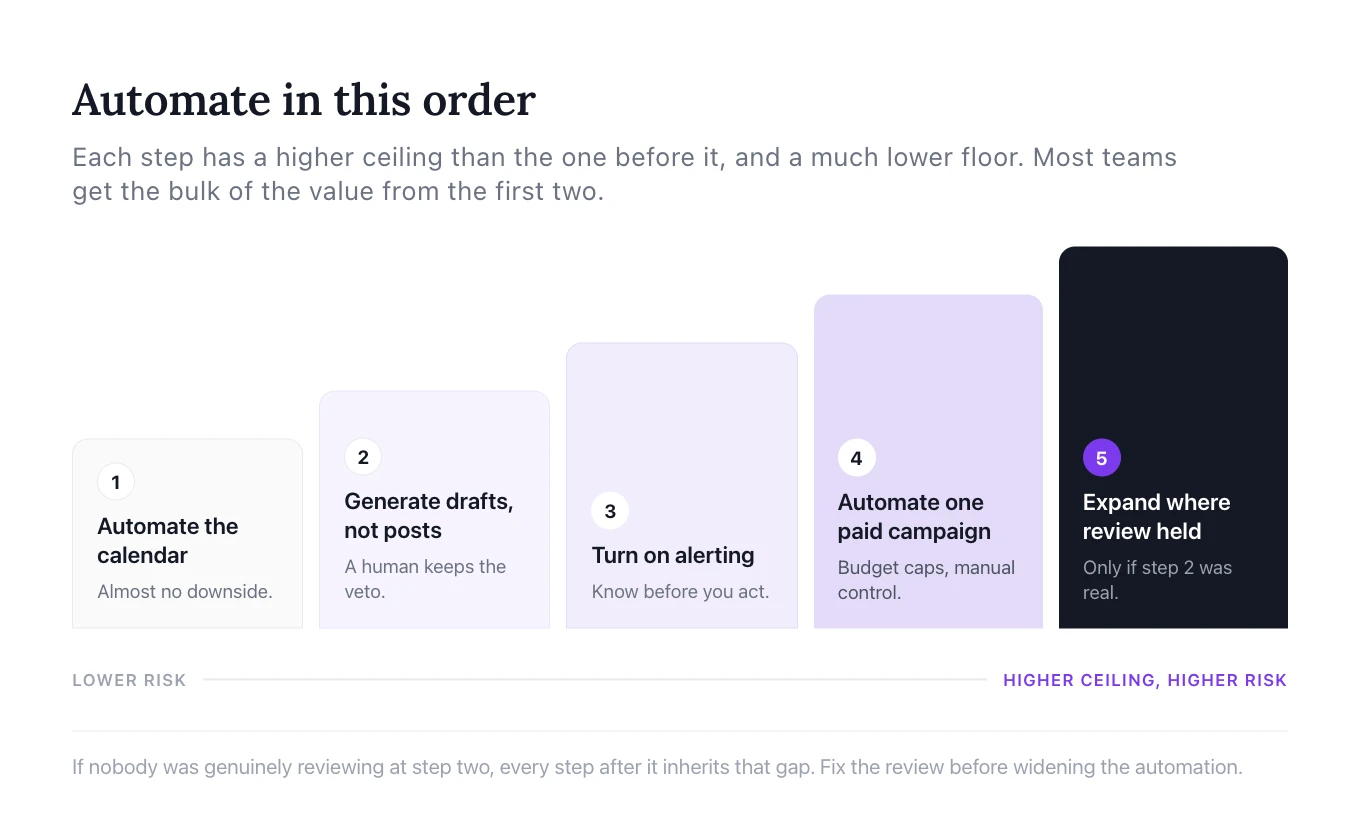
A sensible sequence, in order of risk:
- Automate the calendar. Scheduling, reminders and reposts. Almost no downside, immediate time back.
- Generate drafts, not posts. Let AI produce variants; keep a human approval step with real authority to reject.
- Turn on alerting. Get told when performance moves before you let anything act on it.
- Automate one paid campaign. Pick a low-stakes one, set budget caps, and compare against a manual control.
- Expand only where the review step held. If nobody was actually reviewing at step 2, fix that before automating anything else.
Most teams get the majority of the value from steps one and two. The later steps have a higher ceiling and a much higher floor for going wrong. Agencies managing multiple brands can see how this scales on our for agencies page.
Frequently asked questions
How does AI save time in social media content creation?
It removes the production and coordination layer — ideation, drafting, resizing, scheduling and chasing approvals. That typically turns a multi-hour weekly cycle into a short review session, with the remaining time going to strategy and audience engagement rather than assembly.
What should I look for in an AI social media manager?
Look for reliable multi-format content generation, scheduling, transparent analytics, editable drafts and genuine approval controls. Autonomous campaign changes are useful only when the platform also exposes clear limits, logs and a way for a person to intervene.
How does AI personalize social media campaigns?
Platform systems combine interaction signals such as completed views, likes, shares and skips with audience and contextual data, then adapt which content or creative variant a person sees. You control the available variants and campaign constraints; the platform decides the match.
Can AI detect when social media ads stop working?
Yes. Continuous analytics can flag engagement decline and creative fatigue while a campaign is still live, and some advertising platforms can adjust delivery automatically. The safe starting point is alerting; automate the response only after you trust the signal and have set clear limits.
Is human creativity still necessary?
Yes, and consumers say so directly. AI accelerates production and optimization, but authentic voice, storytelling and judgement calls remain human work — and are exactly what audiences say they want more of.
What is generative engine optimization?
GEO is optimizing content so generative AI systems surface and cite it, rather than optimizing purely for traditional search rankings. Research on the technique reports visibility gains of up to 40% in AI-generated responses.
Where this is heading
Understanding how AI is revolutionizing social media marketing in 2026 is less about the individual features than about where the decisions now sit. Production, scheduling and mid-flight optimization have largely moved to the machine. Voice, judgement and knowing when the metric is lying have not.
The teams that will look good in a year are not the ones that automated everything. They are the ones that automated the parts that were never creative in the first place, and then spent the reclaimed time on the parts that were.