


Choosing between Overvisual vs. traditional social media managers is really a choice between two different cost structures, two different speeds, and two different kinds of risk. Overvisual is an AI platform that generates branded posts, stories and carousels from your business details and schedules them for you, starting at €39 per month. A traditional social media manager is a person who builds strategy, writes original content, talks to your audience and handles the moments when something goes wrong — typically for somewhere between $750 and $7,000 a month depending on scope.
Neither is universally better. The right answer depends on how much content you need, how distinctive your brand voice has to be, and whether the work that actually moves your business is content production or audience relationships.
Editorial disclosure: Overvisual is our product, so we know its workflow more deeply than the alternatives described here. We have tried to be specific about where it is strongest, where a human manager is the better buy, and who should not choose it.
Key takeaways
- Overvisual automates branded content creation and scheduling from €39/month, which suits small businesses that need consistent output more than bespoke strategy.
- Traditional social media managers cost roughly $750–$1,500/month for a basic freelance retainer and $3,000–$7,000+/month for full-service work, and deliver strategy, original creative and community engagement.
- Automating routine production can remove much of the weekly scheduling and assembly work, leaving the owner to review content and engage with customers.
- Human managers remain clearly better at crisis communication, brand storytelling and nuanced audience interaction — the parts of the job where being wrong is expensive.
- A hybrid setup, where AI produces the baseline calendar and a person edits and engages, is a practical answer for businesses that can afford both.
Overvisual vs. traditional social media managers at a glance
| Topic | Key insight | Why it matters | Action item |
|---|---|---|---|
| Overvisual AI platform | Automates content creation and scheduling at low cost | Ideal for small businesses needing consistent social output | Try it where volume, not strategy, is the bottleneck |
| Traditional managers | Provide strategic planning, original creative and community engagement | Essential for complex campaigns and an authentic brand voice | Hire when relationships and reputation drive revenue |
| Time efficiency | AI compresses routine creation, resizing and scheduling work | Frees owner time for work only the owner can do | Automate the routine production layer first |
| Hybrid management | Combines AI automation with human oversight | Balances efficiency with creativity and authenticity | Let AI draft, let a human approve and engage |
| Pricing | Overvisual from €39/month; managers from $750 to $7,000+/month | Aligns social media spend with actual budget | Choose based on budget and required depth of service |
What each option actually does
Overvisual's AI social media manager handles the production line: it generates branded posts, stories and carousels tailored to your niche, then schedules and publishes them, so a consistent presence does not depend on you finding a free evening. A traditional social media manager covers a far wider scope — brand strategy, original content, community engagement, analytics, paid advertising and crisis management.
On cost, Overvisual starts at €39 per month for up to 150 visuals and one brand, with Premium at €59 and Pro at €99 for higher volumes and multiple brands (Overvisual pricing). Freelance and agency social media management sits in a different bracket entirely: a current freelance rate guide lists basic retainers covering one or two platforms at about $750–$1,500 per month, standard packages at $1,500–$3,000, and premium multi-platform work at $3,000–$7,000+ (SolidGigs rate guide).
That gap is the whole argument. It is not that one is good and one is bad — it is that they are priced for different problems.
Specific use cases for Overvisual
Small businesses and startups with limited marketing budgets benefit most from automation. A boutique coffee shop that needs an active Instagram and Facebook presence can generate a month of branded posts and stories in under an hour and get back to running the shop. A freelance consultant can keep a LinkedIn profile warm with minimal effort, which matters because the alternative is usually posting nothing for six weeks and then apologising for it.
The pattern is consistent: Overvisual works when the failure mode is not posting at all. If your content is inconsistent because producing it is tedious, automation fixes the actual problem. If you want to go deeper on story formats specifically, our Instagram story text template guide covers the layouts that tend to hold attention.
When to choose a traditional manager
Larger businesses and brands with complex marketing goals usually need a human. A fashion label launching a collection needs a campaign that ties to a season, coordinates with influencers, and adapts to how the first week actually goes. That is judgement work, not production work.
Traditional managers also earn their fee in a crisis. When a product fails publicly or a post lands badly, the response has to be fast, sensitive and specific — and a bad automated reply in that moment costs more than a year of subscription fees. If your audience talks back a lot, or your category is regulated, or your reputation is the product, hire the person.
The real cost over a year
Annualising makes the trade-off concrete. Overvisual at the Basic tier is €468 a year. A basic freelance retainer at $1,000/month is $12,000. A full-service arrangement at $4,500/month is $54,000. The AI platform is roughly two orders of magnitude cheaper than full-service human management.
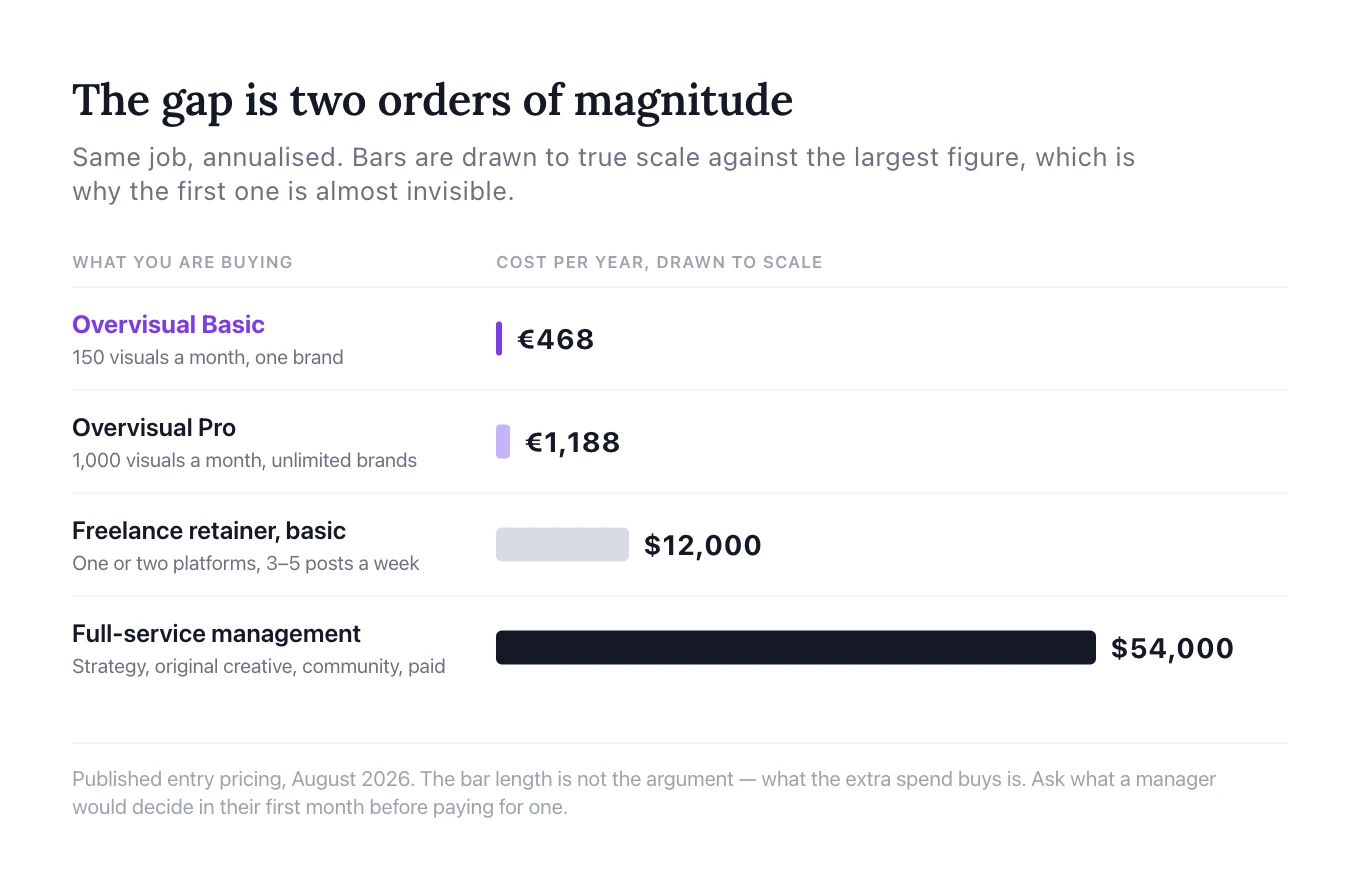
That does not settle it. The right question is what the extra spend buys, and whether that thing generates more than it costs. For a local business selling a straightforward product, the answer is usually no — the content just needs to exist and look right. For a brand whose growth depends on community, partnerships and campaign creative, a good manager can easily return several times their retainer. Spend follows where the leverage actually is.
AI social media managers: features and benefits
AI social media managers change how businesses handle social by automating creation, scheduling and posting. Overvisual generates branded posts, stories and carousels from your niche and brand details, which removes most of the manual work between "we should post something" and a finished, on-brand asset.
Automation compresses the repetitive work of drafting, resizing and scheduling into a review workflow. The core features are multi-platform support, consistent branded output, and automatic scheduling — enough for a small business to keep active profiles without a dedicated hire.
Advanced AI capabilities
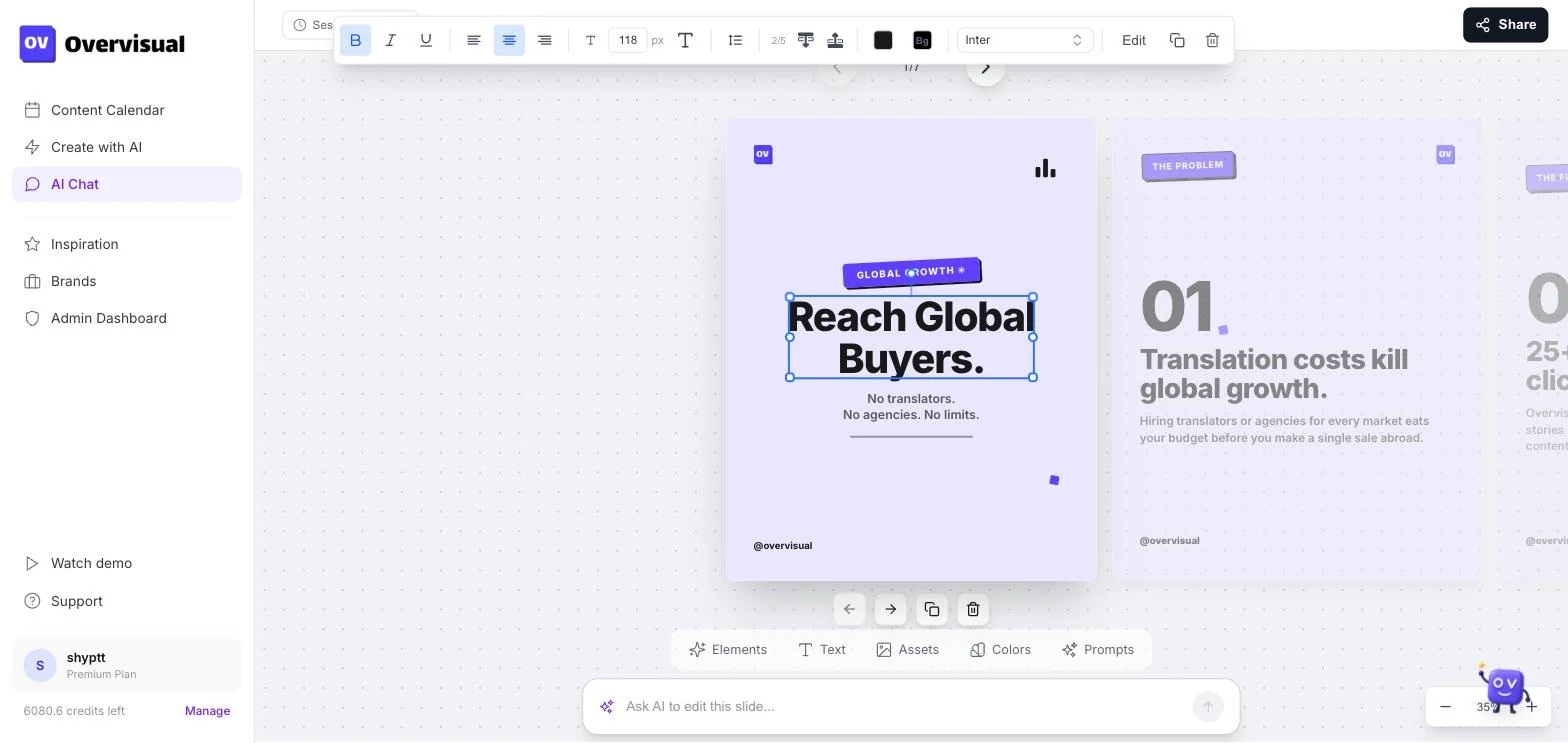
Beyond scheduling, Overvisual analyses your niche and brand details, assists with caption writing, and generates visual content — posts, carousels and stories — without a separate design step. Every draft remains editable before it is scheduled. For a small team, removing the design dependency is often the difference between publishing weekly and publishing whenever someone has time.
Integration and review
Overvisual creates and publishes content for Instagram, Facebook, TikTok and LinkedIn, so multi-channel management happens in one place. Drafts can be reviewed, edited and approved before they enter the schedule, which matters more than it sounds: the approval step is where most AI-generated content gets corrected before anyone sees it. You can see the full workflow on the Overvisual features page.
What AI still gets wrong
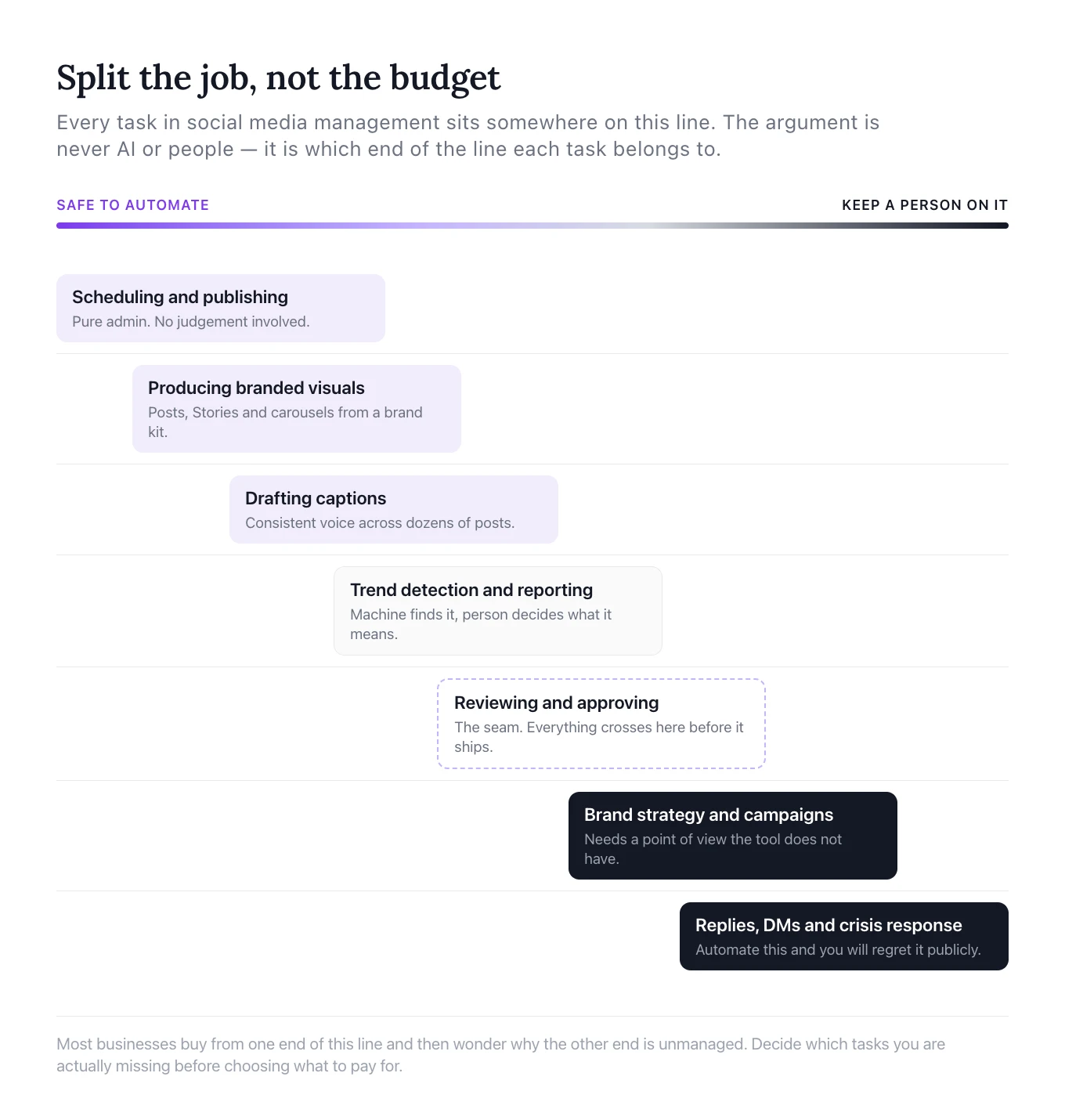
Being honest about the limits is more useful than a feature list. AI-generated content is good at consistency and bad at surprise. It will reliably produce something on-brand and reasonable; it will rarely produce the post that unexpectedly takes off because it captured a specific cultural moment. It does not know that a competitor just had a bad week, or that your biggest customer posted something you should respond to.
It also cannot own a relationship. Replying to comments with generated text is detectable and, in most categories, actively harmful. Treat AI output as a strong first draft that a human signs off on — that framing avoids nearly every way this goes wrong.
Traditional social media managers: roles and value
Traditional managers bring creativity, strategic planning and genuine engagement. Their responsibilities usually span:
- Developing and executing social media strategy aligned to business goals
- Creating original content with a consistent brand voice
- Engaging communities to build trust and loyalty
- Analysing performance metrics to refine campaigns
- Managing advertising and crisis situations with human judgement
They cost more and take longer, but that expertise produces authentic audience connection, campaigns with a point of view, and adaptive responses to market shifts.
Strategic planning and brand voice
Human managers are good at building strategy that connects to the rest of the business. They read market trends, competitor activity and audience insight, then design campaigns that land emotionally. Holding a consistent, authentic brand voice across platforms is a subtle skill that depends on understanding both brand values and audience psychology — and it degrades quickly when nobody owns it.
Community engagement and crisis management
Engaging through comments, messages and user-generated content builds loyalty. A person picks up nuance in a conversation, responds with the right tone, and builds actual relationships. In a crisis — bad publicity, a recall, a post that reads wrong — human judgement is what keeps a small problem small.
Creative content development
Traditional managers often work with photographers, designers and videographers to produce original, high-quality work. They tailor campaigns to seasonal moments, launches and cultural events, adding freshness that generated content tends to lack. That human touch usually drives higher engagement and deeper connection.
What you are actually buying at $3,000+ a month
At the top of the range you are not paying for more posts. You are paying for someone who notices things: that a format stopped working, that a competitor changed positioning, that a comment thread is turning. You are also paying for accountability — a person who owns the number and can explain last month.
If you would struggle to name what that person would decide in their first month, that is a strong signal you need production capacity rather than a strategist, and the cheaper tool is the correct buy.
The future: AI and humans together
The most effective approach blends AI automation with human creativity and oversight. AI handles repetition — scheduling, analytics, consistent posting — which frees a human to focus on voice, community and the judgement calls.
This hybrid model uses each side for what it is good at. Tools like Overvisual keep content flowing and surface data; people supply context, emotional intelligence and direction. Our guide to leveraging automation and AI to maximize social media engagement goes deeper on making that split work in practice.
Hybrid workflow models
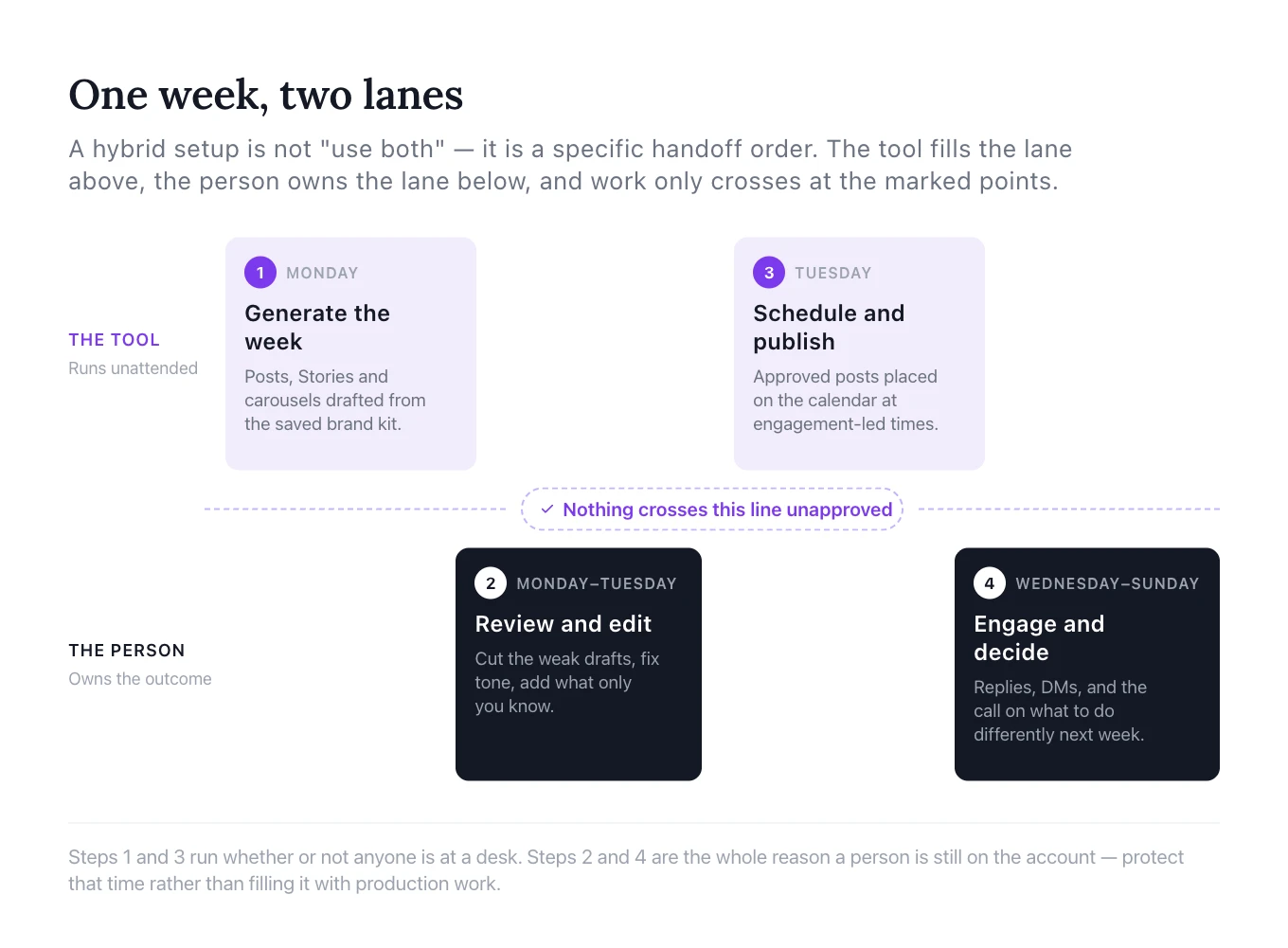
Businesses running hybrid workflows typically assign AI to generate and schedule routine posts, handle hashtag research and monitor analytics. A human then reviews drafts, adjusts tone and context, and engages directly with the audience. The result is better resource allocation, less burnout, and a brand voice that still sounds like a brand.
A practical division: let the tool own the calendar and the baseline output, and let the person own anything a customer will read a reply to.
AI's role in trend detection and reporting
AI systems analyse large volumes of social data to detect emerging trends, sentiment shifts and competitor activity in near real time. That intelligence lets a human adapt quickly — capitalising on an opportunity or heading off a risk. Speed from the machine, judgement from the person.
Challenges and ethical considerations
As AI gets more embedded, businesses have to think about data privacy, content originality and the risk that over-automation makes every interaction feel impersonal. Human oversight is what keeps ethical standards intact and brand values central. Disclose AI use where your audience would care, and never automate a reply to a complaint.
Overvisual pricing and plans
Overvisual's plans start at €39 per month for Basic — up to 150 visuals and one brand — with Premium at €59 (up to 500 visuals, three brands) and Pro at €99 (up to 1,000 visuals, unlimited brands). Annual billing saves 20% (Overvisual pricing). Every plan includes automated branded content creation, scheduling and publishing across platforms.
Set against traditional management at thousands per month, this is a budget-level line item for small businesses that need consistent output. The plans scale as the business grows rather than requiring a new hire.
Plan features and scalability
The base plan covers AI-generated posts, stories and carousel content matched to your niche, with scheduling across major platforms. Higher tiers add brand capacity and volume plus priority support. Starting small and expanding is the normal path — most businesses discover their real volume needs only after a month or two of actually publishing.
Comparison with competitors
Against other tools, the positioning is about what gets automated. Buffer is a strong scheduler with a free plan for up to three channels and paid plans from $5 per channel per month (Buffer pricing). Sprout Social targets larger teams with deep analytics and engagement workflows from $79 per seat per month (Sprout Social pricing). Both assume you already have content. Overvisual's difference is generating the branded visuals and copy in the first place — useful if creation, not distribution, is your constraint.
For a wider view of the category, see our top 10 AI social media manager tools comparison, or the alternatives to Buffer roundup if scheduling is your main need.
Return on investment
By cutting the time and cost of social media management, Overvisual lets you put resources into other growth areas. The efficiency gain usually shows up as higher posting frequency first, then better engagement, then leads — in that order, over a few months rather than a few weeks. Judge it on whether you are publishing consistently three months in, not on week-one metrics.
How to decide in five questions
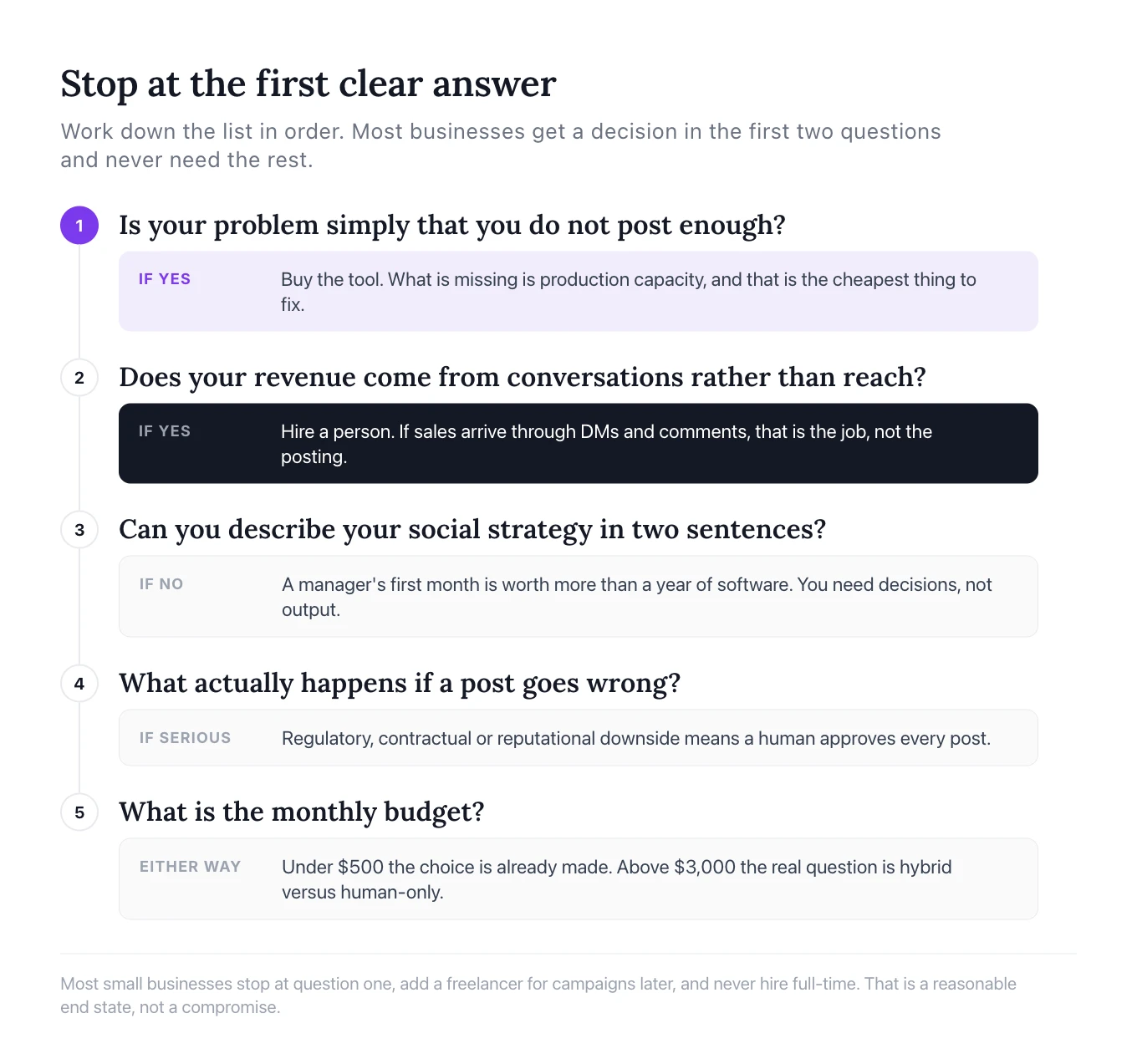
If you want a quick answer, work through these in order and stop at the first clear yes.
- Is your problem that you do not post enough? If content simply is not getting made, buy production capacity. Start with the tool.
- Does your revenue depend on conversations rather than reach? If sales come from DMs, comments and relationships, hire a person.
- Can you describe your strategy in two sentences? If yes, you need execution, not strategy. If no, a manager's first month is worth more than a year of software.
- What happens if a post goes wrong? If the downside is embarrassment, automate. If it is regulatory, contractual or reputational, keep a human in the loop.
- What is your monthly budget? Under about $500, the choice is already made. Above $3,000, the real question is hybrid versus human-only, not whether to use AI at all.
Most small businesses land on the tool, add a freelancer for campaigns, and never hire full-time. That is a reasonable outcome, not a compromise. Business owners can see how this maps to their situation on our for business owners page.
Frequently asked questions
What are the two best social media management platforms today?
There is no single answer, because the category splits by job. Overvisual is strongest when you need branded content generated and scheduled automatically. Sprout Social and Hootsuite are stronger when you need deep analytics, social listening and multi-seat engagement workflows. Buffer sits between them as a straightforward scheduler. Pick by which part of the work is your bottleneck.
Will AI replace social media marketing?
No. AI automates repetitive production and analytics, but it does not replace strategy, relationships or judgement. The realistic outcome is fewer people doing the mechanical parts and more time spent on the parts that need a person. A hybrid approach consistently outperforms either extreme.
How does AI social media management save time?
It compresses the production and admin layer — drafting, designing, resizing and scheduling — into a shorter review workflow. The remaining time goes to checking the output, refining the strategy and engaging with the audience.
What tasks do traditional social media managers handle?
Strategy development, original content creation, community engagement, analytics, paid advertising and crisis management. The scope is much broader than posting, which is why the cost is much higher.
Can I use both an AI tool and a social media manager?
Yes, and it is the most common setup above a certain budget. The tool produces the baseline calendar and handles scheduling; the manager edits, runs campaigns and owns audience relationships. This usually lets a freelancer cover more brands, or lets one in-house person do the work of a small team.
What is the 5-3-2 rule on Instagram?
Post five industry-related pieces, three sharing others' content, and two personal or behind-the-scenes posts, for every ten posts. It is a rough guide for keeping a feed varied rather than a rule, but it is a useful check if your account has drifted into pure promotion.
The verdict
Choosing between Overvisual vs. traditional social media managers comes down to what is actually blocking you. If content is not getting made, buy the tool — it solves that problem for a rounding error of a manager's fee. If your growth depends on strategy, creative range and real conversations with an audience, hire the person, because no tool does that job yet.
Most businesses will end up with both eventually, in the order that matches their constraint: automate production first, add human judgement where it compounds. Start by being honest about which half of the work you are actually missing.